


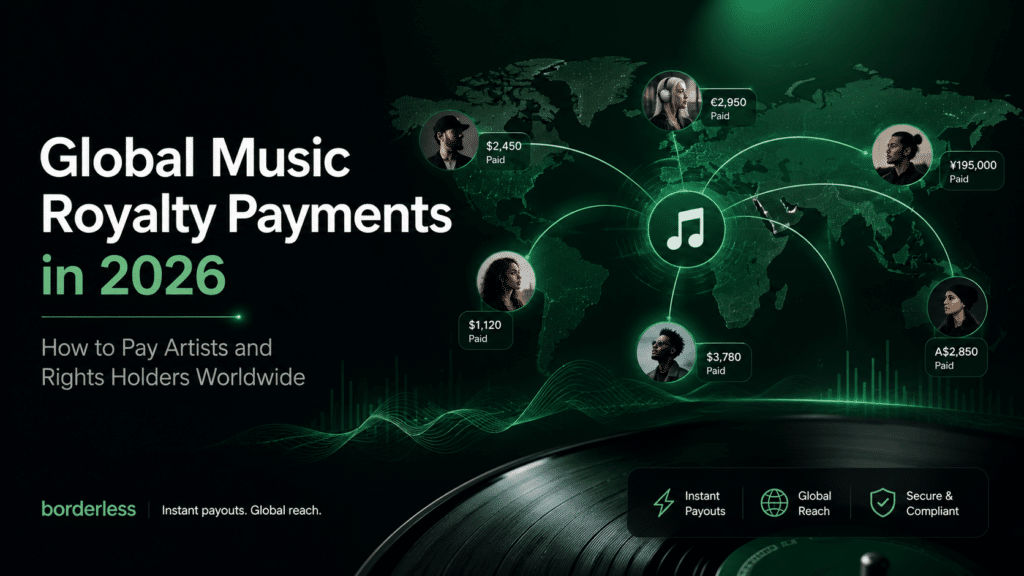
Key Takeaways
- Music royalty payouts get operationally complex quickly when payees are spread across multiple countries, currencies, and tax regimes.
- The biggest friction points are usually payee onboarding, tax documentation, payout method coverage, and bulk disbursement workflows.
- General payment tools can help at low volume, but often leave gaps once royalty payouts become global and recurring.
- Music platforms, distributors, and royalty businesses need payout infrastructure that supports compliance, self-serve onboarding, and mass payouts at scale.
- borderless is relevant for this use case because it combines global payout coverage, compliance automation, and flexible delivery methods in one workflow.
Introduction
Paying music royalties sounds simple until you try to do it across dozens of countries, currencies, tax rules, and payout preferences.
A songwriter in Brazil wants to get paid in BRL through a local bank transfer. A producer in South Korea expects a fast payout in KRW. A rights holder in Germany needs the right tax treatment and supporting documentation. Then multiply that across hundreds or thousands of payees, each with different roles, payment terms, and onboarding requirements.
That is where royalty operations usually break.
For music platforms, distributors, labels, and royalty management companies, the real challenge is not just calculating what each person is owed. It is collecting the right tax forms, onboarding payees at scale, supporting payout methods that work locally, and sending accurate payments without turning ops into a manual cleanup function.
In 2026, teams are no longer asking whether global royalty payouts are possible. They are asking which infrastructure can actually handle them without creating more work.
Why Music Royalty Payouts Break at Scale
Music royalties are one of the more operationally complex payment categories because the money crosses borders and the recipient structure is fragmented.
One song can generate revenue in dozens of markets and trigger payouts to multiple parties at once. That can include a recording artist, songwriter, producer, publisher, label, distributor, or rights administrator. Each may sit in a different country, need a different payout method, and fall under a different tax treatment.
The complexity compounds in three ways:
- More payees
- More countries
- More compliance requirements
At low volume, teams often patch the process together with spreadsheets, wires, PayPal, and manual reviews. That might work for a while. It stops working once payout runs involve hundreds or thousands of recipients.
At that point, the problem is no longer, “How do we send money?” It becomes, “How do we run a repeatable payout operation?”
Who Actually Needs to Get Paid
A royalty payout system usually has to support more recipient types than finance teams expect upfront.
Common payees include:
- Recording artists receiving master royalties
- Songwriters and composers receiving publishing royalties
- Producers receiving rev share or flat-fee payments
- Labels and rights holders receiving mechanical or performance royalties
- Session musicians receiving one-time or recurring payments
- Distributors or intermediaries paying onward to their own roster
These groups do not behave the same operationally.
Some are individuals. Some are businesses. Some are US taxpayers. Some are non-US payees. Some want bank transfers. Others prefer wallets or market-specific methods. Some require recurring payouts. Others are paid in batches only a few times a year.
That is why generic payment tooling often becomes a poor fit. Royalty payouts are not one payment flow. They are multiple payout flows sitting inside one business process.
Where Global Royalty Payouts Get Operationally Messy
Currency and Payout Method Fragmentation
Country coverage is not the same thing as usable payout coverage.
It is one thing to say you can send money to 190 countries. It is another to support the payout methods people in those countries actually want to use.
A rights holder in Japan may want a local transfer in JPY. A payee in Nigeria may prefer mobile money. A US-based artist may expect ACH. If your payout system only supports wires or a narrow set of methods, the result is usually one of three problems:
- Higher payout costs
- Worse recipient experience
- More manual exceptions for ops
This is where many payout setups fall short. They offer theoretical reach, but not practical delivery.
Tax Compliance Across Borders
Tax is where royalty payouts get risky.
If you are paying US recipients, you may need 1099 reporting. If you are paying non-US persons receiving US-source royalty income, you may need W-8 collection, withholding logic, and 1042-S reporting. If those workflows are missing or manual, the finance team ends up carrying unnecessary exposure.
And this is not just a US issue. Cross-border payouts create local tax and compliance questions in multiple markets. The rules vary by recipient type, jurisdiction, and income classification.
Teams often underestimate this part because they focus first on sending the money. In practice, the tax layer is what determines whether the payout process scales cleanly or becomes an annual compliance problem.
Payee Onboarding at Scale
You cannot pay someone correctly if their onboarding is incomplete.
That means collecting:
- Banking or wallet details
- Identity information when required
- Tax forms and supporting documentation
- Local payout data in the right format
This becomes painful quickly if the process is manual.
For a platform paying hundreds or thousands of artists and rights holders, onboarding has to be self-serve, guided, and built for international variation. Different countries use different bank formats, different tax documents, and different verification workflows.
If onboarding is clunky, payees stall. If it is manual, ops gets buried.
Bulk Disbursement Complexity
Royalty payouts are rarely one-off transactions. They are usually batch events.
Finance teams may need to pay hundreds or thousands of people in one run, reconcile results, retry failures, answer payee questions, and keep records clean for reporting.
That is not something you want to manage one payment at a time.
A workable setup needs to support bulk disbursements through file upload, API, or both, with enough visibility to track payment status and resolve issues without investigating each payout manually.
How Music Platforms Usually Handle Payouts
Most teams start with one of a few approaches.
Manual Bank Wires
This works at very low volume and breaks quickly after that.
Wires are expensive, operationally heavy, and not built for recurring mass payouts. There is no embedded onboarding, no built-in tax workflow, and very little automation.
PayPal or Wise
These are common starting points because they are easy to access.
The tradeoff is that they are not built around royalty-specific payout operations. Tax reporting, onboarding controls, and market-specific payout coverage may be limited depending on the use case.
Stripe Connect
Stripe has a strong developer experience and works well for many payment products.
But royalty payouts introduce a different set of requirements. If you need built-in support for workflows like W-9 and W-8 collection, 1099 or 1042-S reporting, and bulk payout operations for large recipient groups, a general-purpose payments platform can leave meaningful gaps.
Enterprise AP Platforms
Traditional AP and supplier-payment platforms can cover parts of the problem, especially for finance-led teams.
The issue is that many are designed more for accounts payable than for platform payouts. That can mean slower implementation, more rigid workflows, and a weaker embedded experience for product teams that want payee onboarding and payout flows to feel native.
What to Look for in a Global Royalty Payout Platform
If you are evaluating infrastructure for music royalty payouts, these are the capabilities that matter most.
Real Country and Payout Method Coverage
Do not just ask which countries are covered. Ask which payout methods are supported in those countries and whether they are actually usable for your recipients.
Built-In Tax Workflow Support
If royalty payouts touch US recipients or US-source income, tax documentation and year-end reporting should not live in separate tools or manual spreadsheets.
Look for support for:
- W-9 collection
- W-8 collection
- 1099 workflows
- 1042-S workflows
- Withholding support where relevant
Self-Serve Payee Onboarding
Your team should not be keying in bank details and chasing artists for forms over email.
A good system lets payees onboard themselves through a guided flow, with support for international bank formats and the documentation needed to pay them correctly.
Bulk Payout Support
Royalty runs are batch workflows. The system should support mass disbursements without forcing finance teams to process each payment one by one.
API-First and Embeddable Options
If you are a platform, distributor, or product-led company, you may want the payout experience to live inside your own product. That means looking for REST APIs, embedded workflows, or white-label options.
Security and Compliance Posture
Any provider handling recipient data and payout operations at scale should meet baseline security requirements. Finance and product teams should not treat this as optional diligence.
How borderless Fits Music Royalty Payouts
borderless is relevant for music platforms and royalty businesses that need to pay artists, producers, and rights holders globally without stitching together multiple systems.
What makes it a fit is not just country reach. It is the combination of payout operations, payee onboarding, and compliance support in one workflow.
Global Payout Coverage
borderless supports payouts across 190+ countries and multiple payout methods, which matters when your payee base spans different markets and recipient preferences.
Support for Tax-Heavy Payout Workflows
For teams dealing with royalty-related tax complexity, built-in support for workflows like 1099 and 1042-S matters. It reduces the need to bolt tax handling onto a separate payout process.
Self-Serve Onboarding
When artists and rights holders can enter their own payout and tax details through guided onboarding, ops teams spend less time chasing documentation and cleaning up avoidable errors.
Bulk Disbursements
Royalty payouts often happen in large runs, not isolated transactions. borderless supports mass payout workflows built for that model.
API and No-Code Flexibility
Some teams want embedded payout infrastructure inside their platform. Others want finance to run operations without engineering resources. borderless supports both models, which is useful for companies at different stages of scale.
FAQ
What is a music royalty payment?
A music royalty payment is money paid to a rights holder for the use of music. That can include artists, songwriters, producers, labels, publishers, or other parties entitled to revenue from streaming, licensing, downloads, performance, or related uses.
Why are international royalty payouts difficult?
Because the payout is rarely just a payment problem. It usually involves multiple countries, different payout methods, tax documentation, recipient onboarding, and large batch workflows.
What tax forms matter for music royalty payments?
That depends on the payee and where the income is sourced, but teams commonly need to think about W-9s, W-8s, 1099 reporting, and 1042-S reporting when US tax rules apply.
Can I use a general payment platform for royalties?
Sometimes, especially early on. But once royalty payouts involve many payees, multiple countries, and tax-heavy workflows, general tools often require too much manual work or leave important gaps.
What should a royalty payout platform do well?
It should help you onboard payees, collect the right tax information, support payout methods that work locally, run bulk disbursements, and reduce manual operations for finance and ops.
Conclusion
The hardest part of music royalty payouts is usually not calculating what people are owed. It is turning that obligation into a clean global payment workflow.
That means onboarding payees correctly, collecting tax documentation, supporting local payout methods, and sending large payment runs without breaking your ops team.
For music platforms, distributors, and royalty businesses, that is the difference between a payout process that works for a quarter and infrastructure that works long term.
If you’re paying artists and rights holders across markets, borderless is built to help simplify that layer.
About borderless
borderless powers instant global payouts for marketplaces, creator platforms, gig networks, and digital platforms. With coverage in 190+ countries, real-time FX, compliance automation, and support for bank accounts, debit cards, PayPal, Venmo, and wallet payouts, borderless is the simplest way to scale global payouts from hundreds to hundreds of thousands.
#MusicRoyaltyPayments #GlobalMusicPayments #ArtistPayouts #CrossBorderPayments #RightsHolderPayments #borderless