


Key Takeaways
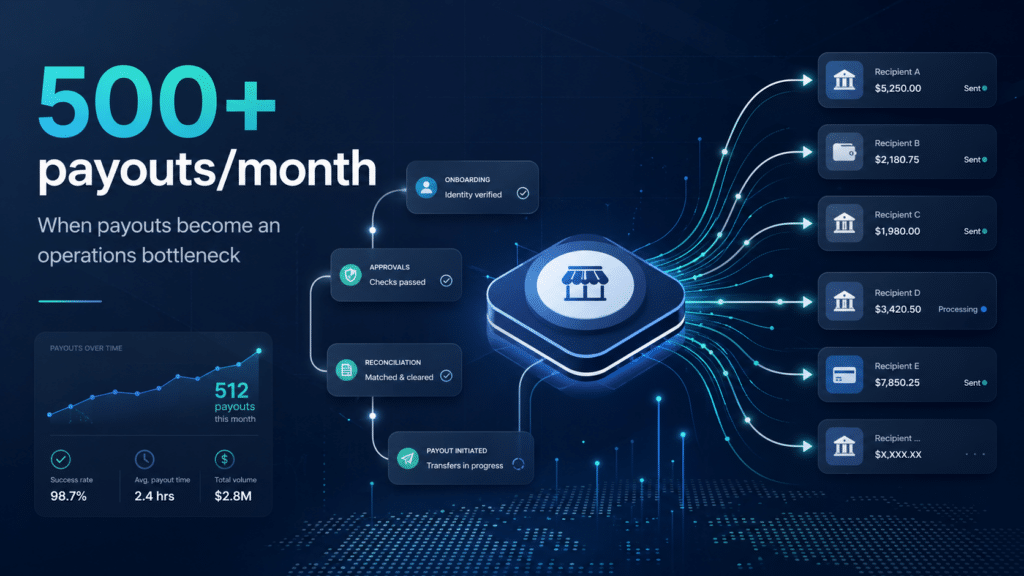
- Around 500+ payouts a month, payout complexity usually stops being occasional and starts becoming structural.
- The real problem is rarely just moving money. It is the operational layer around onboarding, approvals, failed transfers, reconciliation, and recipient support.
- When payout operations break, the impact shows up in seller trust, activation, retention, and internal team efficiency.
- The earlier a platform fixes payout infrastructure, the easier it is to scale without adding operational drag.
Introduction
At the beginning, marketplace payouts often feel manageable. A small team can review exceptions manually. Finance can work through the occasional failed transfer. Support can answer seller questions as they come in. Even if the workflow is not elegant, it still feels contained.
That usually changes faster than teams expect.
Once a marketplace starts sending hundreds of payouts a month, payout operations stop being a simple back-office task. They become a system that touches onboarding, seller experience, finance, compliance, and support all at once.
At that stage, the issue is no longer whether the platform can send money. The issue is whether it can keep sending money without creating more manual work, more trust issues, and more friction every month.
That is why 500+ payouts a month often feels like a breaking point. It is not a magical number. It is the stage where complexity starts showing up often enough to slow the business down.
Why 500+ Payouts a Month Changes the Operating Model
At low volume, a marketplace can absorb inefficiency.
A few payout exceptions do not seem like a system problem. A manual bank-detail fix here, a delayed approval there, a spreadsheet-based reconciliation process at the end of the week all of it still feels survivable.
At higher volume, those same issues stop behaving like isolated incidents. Every additional seller, vendor, or service provider adds more payout details to collect, more edge cases to review, more payout statuses to track, and more support questions to resolve.
Growth does not just increase payout volume. It increases the number of things that can go wrong before, during, and after money is sent.
That is the shift many platforms miss. The team may still think it has a payments workflow, but in practice it is now running an operations layer around payouts.
The Real Work Is Everything Around the Payout
Most payout problems are not created by the transfer itself. They are created by everything surrounding it.
A seller has incomplete onboarding details. A payout method does not fit the recipient’s location. An approval is delayed internally. A transfer fails because account information was entered incorrectly. Finance needs visibility into what was sent, what settled, and what still needs attention. Support has to explain timing to a seller who only knows that their earnings have not arrived.
In practice, payout strain usually shows up as:
- incomplete or confusing recipient onboarding
- failed or delayed transfers that require manual follow-up
- fragmented visibility across finance, operations, and support
That is why marketplaces often underestimate payout complexity. The money movement is only one part of the job. The real burden comes from coordinating onboarding, recipient data collection, exception handling, approvals, reporting, and communication across multiple teams.
When those pieces are fragmented, payout volume starts creating operational drag long before leadership calls it a payout problem.
What Starts Breaking First
The first sign is usually not a dramatic system failure. It is a rise in small recurring friction.
Support starts seeing more payout-related questions. Finance spends more time tracing payment statuses across systems. Operations gets pulled into more exception handling. Product hears complaints that payouts feel slow or unclear.
Then sellers start treating the payout experience as a reflection of the marketplace itself.
This matters because marketplaces do not just compete on demand and supply. They also compete on reliability.
If sellers feel uncertain about when they will be paid, how they will be paid, or what they need to do to receive funds, trust starts eroding. Even when the issue appears operational internally, the external impact is commercial.
- Sellers become less confident in the platform.
- Active participation gets harder to maintain.
- Retention and word of mouth start taking avoidable hits.
Why This Becomes a Trust Problem, Not Just a Finance Problem
For a marketplace, payouts are one of the clearest moments where the platform proves it works.
A seller can tolerate a lot while building on a platform. But once earnings are involved, expectations get sharper. People want clarity, reliability, and control. They want onboarding to make sense. They want payout timing to feel predictable. They want enough payout method flexibility to match how they actually operate.
When that experience feels clunky, the platform feels clunky.
That is why payout operations influence more than internal efficiency. They shape seller trust. And seller trust affects activation, repeat participation, retention, and word of mouth.
A marketplace may think it has a payout ops issue. In reality, it may have a growth issue that is showing up through payouts first.
The Hidden Cost of Waiting Too Long
Many teams postpone fixing payout infrastructure because the current process still “works.”
Usually, that means the process works only because people are compensating for it manually.
Someone is checking spreadsheets before payouts go out. Someone is following up on failed transfers. Someone is resolving seller confusion through support tickets. Someone is stitching together reporting for reconciliation. Someone is handling one-off approvals outside the intended workflow.
That kind of patchwork can last longer than it should, which is exactly why it becomes dangerous. The marketplace keeps growing, but the payout layer stays dependent on manual effort.
By the time leadership recognizes the system is strained, internal teams are already spending too much time maintaining something that was never built to scale cleanly.
The cost is not just inefficiency. It is slower execution across the business.
What Scalable Marketplace Payout Operations Need
A marketplace does not need more complexity in its payout stack. It needs fewer failure points.
That usually starts with:
- smoother recipient onboarding
- payout method coverage that matches the seller base
- internal visibility into status, exceptions, approvals, and settlement activity
- a payout setup that fits how the marketplace actually operates
For some teams that means API-based control. For others it means embedded workflows, dashboard tools, approvals, or a combination of technical and operational flexibility.
The common requirement is not just payment delivery. It is operational leverage.
That is the real standard marketplaces should evaluate against.
Questions Marketplace Leaders Should Be Asking Now
A marketplace does not need to wait for a major payout failure to know there is a problem.
A few practical questions usually make the issue visible quickly:
- How many payouts are we sending each month, and how quickly is that number increasing?
- How many manual steps still exist between seller onboarding and successful payout delivery?
- How often do payout issues create work for support, operations, or finance?
- How much visibility do we have into failed transfers, pending approvals, and payout status?
- If payout volume doubled in the next two quarters, would the current workflow hold up without adding more manual work?
FAQ
Why does payout complexity increase so quickly after a marketplace starts scaling?
Because payout growth brings more than higher payment volume. It also brings more seller onboarding cases, more payout preferences, more failure scenarios, more approvals, and more reconciliation work across teams.
Is 500 payouts a month the exact threshold for every marketplace?
No. The number is not universal. It is a useful marker for the stage where payout complexity often stops being occasional and starts becoming structural.
Why are marketplace payouts a trust issue?
Because payouts are one of the most visible moments where sellers judge the platform. If payment timing, onboarding, or payout clarity feels unreliable, trust in the marketplace drops quickly.
What should marketplace operators prioritize first?
Start by identifying where manual work is accumulating: onboarding, payout detail collection, approvals, failed transfer handling, reconciliation, or support. The biggest recurring friction usually points to the real scaling constraint.
Conclusion
The biggest mistake marketplaces make is assuming payout complexity begins when money cannot be sent.
In practice, the real problem starts earlier. It starts when seller onboarding, payout operations, approvals, reconciliation, and support all begin getting heavier at the same time. That is the point where payouts stop being a simple workflow and start becoming infrastructure.
Once that shift happens, the question is no longer whether the marketplace can send funds. The question is whether it can keep scaling payouts without weakening trust or increasing operational burden every month.
That is the point where the payout layer deserves attention before the bottleneck gets harder to unwind.
About borderless
borderless powers instant global payouts for marketplaces, creator platforms, gig networks, and digital platforms. With coverage in 190+ countries, real-time FX, compliance automation, and support for bank accounts, debit cards, PayPal, Venmo and wallet payouts, borderless is the simplest way to scale global payouts from hundreds to hundreds of thousands.
#marketplaces #globalpayouts #platformops #fintech #payouts #getborderless #operations #payoutops